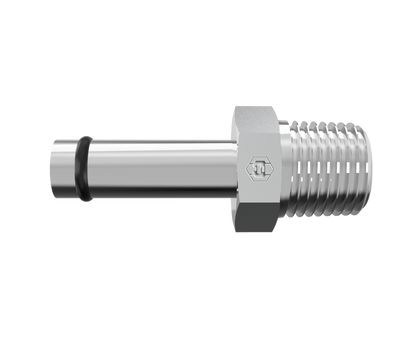
Hose End Fittings
Terminating a hose is a different problem from terminating rigid tube. A tube end keeps whatever shape it is given; a hose end is layered elastomer over wire or textile reinforcement that creeps and swells under pressure. So the fitting does two jobs: grip hard enough that line pressure cannot walk the hose off the stem, and seal against the bore or cover while that grip stays live.
Which makes retention, not the far-end thread, the decision that matters. The port end is ordinary work answering to SAE J514, J1453, J1926 or ISO 228; retention sets the pressure the assembly holds, whether it can be built in the field, and whether it comes apart again.
Where it's specified
- Barb and clamp — a serrated stem with a worm-drive or ear clamp: low to moderate pressure, assembled anywhere with a screwdriver and re-made in minutes
- Crimped ferrule — a collar swaged to a specified diameter with a die set: the highest retention and the realistic choice on wire-braid hose, but permanent and machine-made
- Reusable field-attachable — a socket screwed onto the cover with a nipple driven into the bore: no crimper, recoverable when the hose is replaced, but lower rated
- Matching the hose, not just the ID — cover OD, reinforcement and tube compound decide which stems fit and which crimp holds
Range and materials. Hose Barb Fittings sits beneath this page: serrated stems as straights, 90° elbows, tees and splices, with the far end as NPT, a 37° flare seat or a second barb, in brass and steel.
Ordering notes. Size the barb to hose ID, never to the thread on the other end — a 1/2" NPT body with a 3/8" barb is a normal part, not an error. Push the hose fully onto the shoulder before clamping, with the clamp over the serrations. On crimped assemblies take crimp diameter and die number from the hose maker's chart for that exact pairing.