
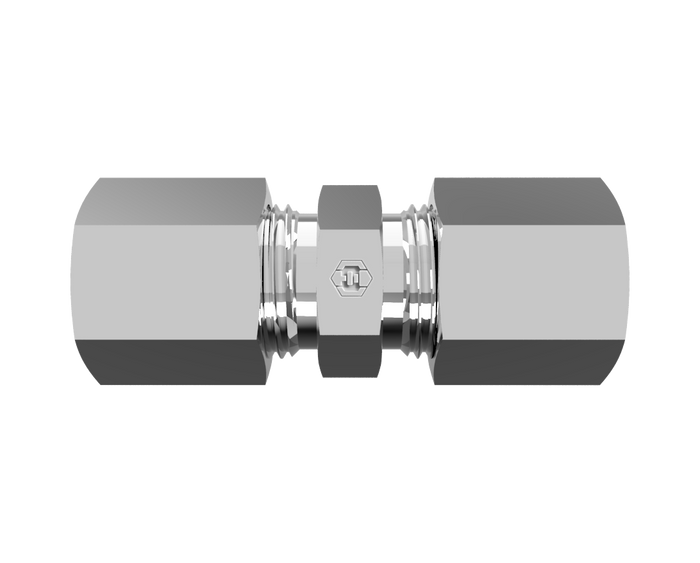
Steel Flareless Bite Type Fittings
A flareless fitting seals by cutting. Tightening the nut drives a hardened ring along the internal taper in the body until its leading edge bites a shoulder into the outside of the tube, and that shoulder both grips against pull-out and forms the seal. All of it rests on one relationship: the ring must be harder than the tube. If it is not, the edge rolls over instead of biting.
Hardened steel rings on steel tube is the exact combination the DIN 2353 and ISO 8434-1 system was designed around, which is why the range behaves most predictably in carbon steel. The tube matters as much as the fitting; soft or thin-walled tube collapses under the bite instead of taking one. Steel is also the highest-pressure and lowest-cost material here, and forgiving enough that a nut can be run down and re-set without the galling stainless suffers.
Where it's specified
- Metric steel tube systems — ring, body and tube share the hardness relationship the standard assumes
- Assembly without flaring equipment — a square-cut, deburred tube end is the whole preparation
- Vibrating machine runs — the bitten shoulder locks the tube mechanically rather than by friction
- Heavy-series duty — S series bodies take the upper end of the pressure range where L series stops
Range and materials. Straights, 45° and 90° elbows, tees, crosses, bulkheads, unions and reducers in light (L) and heavy (S) series, with port ends in BSPP, metric, NPT, JIC 37° and ORB. Bodies, nuts and rings are carbon steel, trivalent (Cr3+) zinc plated, and ship assembled.
Ordering notes. Pre-set the ring in a pre-setting tool or hardened body before final assembly, and keep each nut, ring and tube end together as a matched set once it has bitten. L and S are not interchangeable — the same nominal tube OD carries a different thread and ring in each — so order by series and tube OD together.
No product families match these filters.