
Steel ORFS Fittings
An O-ring face seal joint seals on a flat machined face rather than on the thread. The male half carries an elastomeric O-ring in a groove cut into that face; drawing up the swivel nut squeezes the O-ring against the mating flat, so the thread only supplies clamp load and takes no part in sealing.
That separation of duties is why ORFS became the default on equipment that vibrates, cycles hard, or gets taken apart in the field. Nothing has to be over-tightened to chase a weep, torque values stay repeatable from one remake to the next, and a joint that has been broken half a dozen times still seals on a fresh O-ring.
Where it's specified
- High-pressure mobile equipment — excavators, loaders and drill rigs where working pressure and shock loading sit close to the limit of the connection.
- Heavy vibration — the face seal is untouched by the thread relaxation that eventually weeps on tapered-pipe joints.
- Contamination-sensitive circuits — servo and proportional systems, where a seeping joint costs fluid and lets dirt in.
- Serviceable assemblies — power units and manifolds that get unbolted, moved and remade during their working life.
Range and materials. Straight adapters and unions, female swivels, elbows at 45° and 90°, run tees, branch tees, crosses, bulkheads, caps, plugs, tube nuts and sleeves, plus conversions to JIC 37° flare, SAE O-ring boss, NPT and NPSM pipe thread, BSPP and metric ports. Bodies are carbon steel finished in trivalent zinc, in dash sizes -04 through -24.
Ordering notes. Nitrile O-rings are fitted as standard and suit most petroleum-based fluids to around 100 °C; specify FKM where temperature, phosphate esters or aggressive media are involved. Tighten to the published torque rather than by feel — the O-ring does the sealing, and over-torque distorts the groove face. For corrosive duty, the same shapes are listed under stainless ORFS.
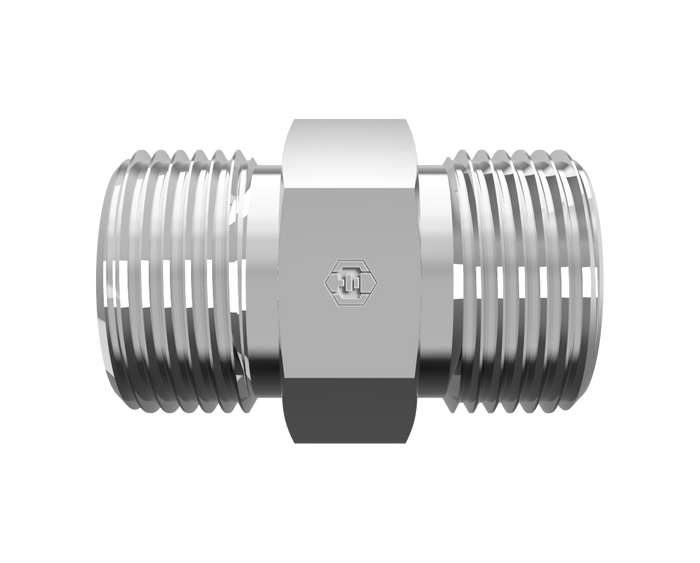
 FS2404Straight Connector
 FS2405Straight Connector
 FS2406Reducing Adapter
FS2408Hex Plug
 FS2500-FG1/4" Male ORFS x 1/4" Male ORFS
 FS2501-FGElbow, Male
 FS2503-FGElbow, Male
 FS2601-FGBranch Tee, Male
 FS2603-FGTee, Union-Style
 FS2650-FGCross, Union-Style
 FS2700Bulkhead Fitting
 FS2701-FGElbow, Bulkhead
 FS2702-FGElbow, Bulkhead
 FS2704-FGRun Tee, Bulkhead
 FS6400-L-OConnector, Male
 FS6400-OConnector, Male
 FS6402Connector, Swivel
 FS6403Straight Adapter
 FS6500-FGElbow, Swivel
 FS6504Adapter, Swivel
 FS6505Connector, Swivel
FS6801-NWO-FGElbow, Adjustable
 FS6802-NWO-FGElbow, Adjustable

No product families match these filters.
Showing 60 of 69 product families. Use part-number search to find a specific family, or browse a more specific category.