
Steel SAE ORB Fittings
An SAE O-ring boss fitting is a port connection, so it spends its life screwed into somebody else's casting. The straight thread pulls it down until the O-ring is trapped in the chamfer at the port face, and two metals then sit in permanent contact. Pump housings, valve bodies and manifolds are steel or iron, which makes a carbon steel fitting the galvanically matched half of that pair rather than a compromise.
Get the pairing wrong and the fitting pays for it: zinc-plated steel threaded into a stainless or aluminium port and then wetted will corrode preferentially at the joint. Matched into iron and steel, the same part is the cheapest and highest-pressure option in the SAE J1926 and ISO 11926 range. Its threads also gall far less than stainless, which matters when an adjustable elbow is backed off and re-seated.
Where it's specified
- Pump, motor and valve ports — the fitting matches the casting instead of setting up a couple with it
- Adjustable elbows and run tees — the outlet is clocked to the hose route, then locked without disturbing the seal
- Tightly spaced manifold blocks — forgiving threads survive the repeated backing-off close spacing forces
- High-pressure port work — the O-ring stays captive in the boss rather than distorting like a crush washer
Range and materials. Adjustable and non-adjustable 45° and 90° elbows, straights, branch and run tees, reducers and plugs, converting at the far end to JIC 37°, ORFS, NPT or BSP. Bodies are free-machining carbon steel, trivalent (Cr3+) zinc plated; adjustable styles ship complete with lock nut and back-up washer.
Ordering notes. Run the lock nut and washer fully up, thread in until the washer meets the port face, then back off no more than one turn to aim the outlet before tightening the nut against the boss. Confirm the O-ring compound suits the fluid, and size by the port thread, not the tube on the other end.
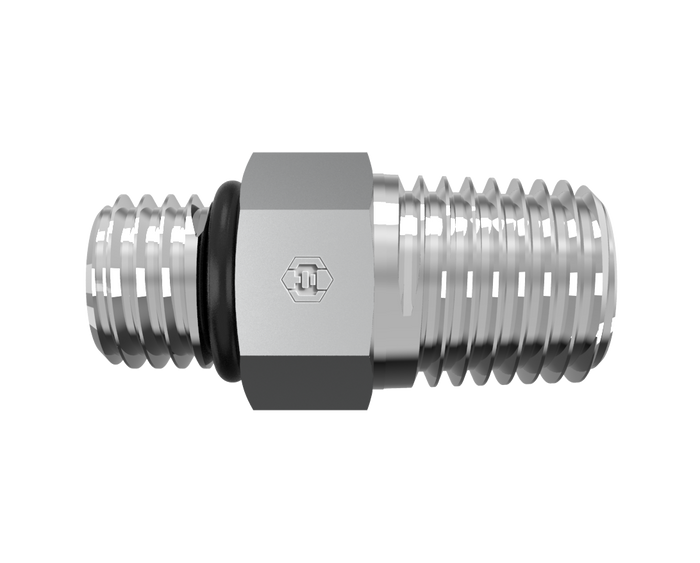
 4603-NWO-FGMale Adjustable Elbow
 4604-OConnector, Male
6400-L-OConnector, Male
 6400-OConnector, Male
 6401-ONipple Adapter
 6402-OConnector, Swivel
 6404Adapter, Male
 6405-OAdapter, Female
 6408-H-O5/16-24 Male ORB
 6408-O5/16-24 Male ORB
 6410-OReducing Adapter
 6420Full Coupling
 6425Full Coupling
 6803-NWO-FGAdjustable Branch Tee
 6804-NWO-FGAdjustable Run Tee
6805-L-NWO-FGAdjustable Elbow
 6805-NWO-FGAdjustable Elbow
 6806-NWO-FGAdjustable Elbow
 6807-NWO-FGAdjustable Elbow
 6815-NWO-FGElbow, Adjustable
 6900-OConnector, Swivel
 6901-NWO-FGSwivel Elbow, Adjustable
 6902-NWO-FGSwivel Elbow, Adjustable
 70623/8-24 Male ORB x 1/4" Male BSPP 60° Line/Port
 FS6400-L-OConnector, Male
 FS6400-OConnector, Male

No product families match these filters.
Showing 60 of 90 product families. Use part-number search to find a specific family, or browse a more specific category.